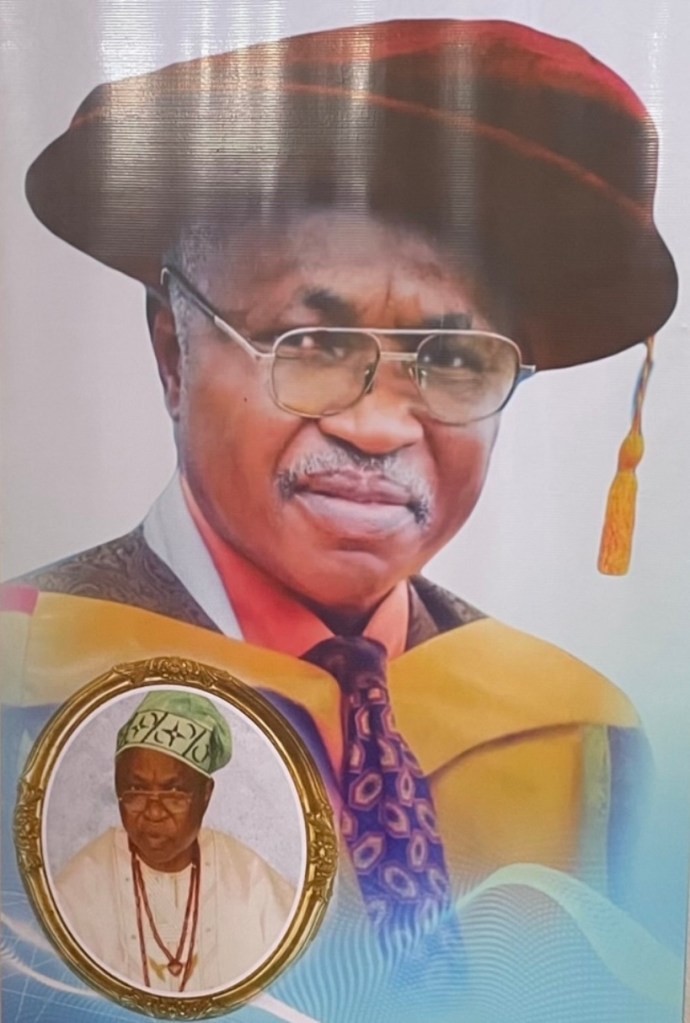
My dad

My dad- Professor Olumuyiwa Akinade Sanda

I have not been able to write since 2021.

I am just having the courage to write. My dad passed in 2021. I have grieved him since then. I am crying as I write this. But I want to write now to remember who my dad was.

I am his only daughter out of seven of us; three of us from my mom.

I miss my dad everyday. Even though, I’m married with three children of mine.

My dad, Professor Olumuyiwa Akinade Sanda was well respected in the community. He loved education. He loved to read. He wrote and authored many books. He loved his country Nigeria and his hometown, Ibadan. He served his people in Nigeria, in the city of Ibadan and even in the rural Alegongo where he was from.

He was a mediator in the family and in the community. I remember as a child, aunts and uncles will come to see him at the house to have their conflicts resolved. I guess that is why I am a Mediator.

Community members came to my dad at the house to have their disputes resolved.

He was kind to his people to a fault.

He finally became the head and chief of the community. He later became The ‘Baale’ of Alegongo.

I will forever be grateful to my dad for his love for me. For how he brought myself and my brothers up to be disciplined.

He was not perfect at home but he gave his best to us his children. He sacrificed everything to make sure we his children got the best in life including education. I am in the United States of America all because of my dad. I will forever be grateful.

I wish I was with him when he passed. I was in the United States and he was in Nigeria.

I am however glad that despite his past mistakes, he found God in his later years. I believe he is with God.

I am praying that my dad’s legacy continues and is forever remembered.

Meet the People Who Keep New Yorkers From Ripping Each Other’s Heads Off – ANIMAL

“Harmonious co-existence is a lofty aspiration for a city as cramped as New York. To help establish peace, and to keep New Yorkers from strangling each other, mediators are scattered across the five boroughs, solving conflicts between families, neighbors and community members.”  Read more at:

http://animalnewyork.com/2015/meet-the-people-who-keep-new-yorkers-from-ripping-each-others-heads-off/?utm_source=dlvr.it&utm_medium=twitter

What is Mediation?

According to statistics, 80% of cases that come through Mediation are resolved.

What is Mediation and how does it work?

Mediation is a voluntary process by which two people come together to try to work out their differences with a neutral third person. Differences could mean, conflict, disagreement or dispute. The neutral person is known as the Mediator.

Mediation is very effective in resolving disputes for a number of reasons.
It affords people an alternative to litigation for the following reasons;

1. It saves time and money

Many litigants are unable to afford the costs associated with Attorney fees. Mediation is a good means or process to spend less money and still have your case heard. Litigation also can take weeks, months and even years to finish whereas in Mediation, you spend less amount of time because you, not the Mediator, are in control of the Mediation process.

2. Happy people

Parties in Mediation are happier and more satisfied with their decision or settlement because they had an input in the decision making. With Litigation or Arbitration, parties are bound by the Judge’s decision or Arbitrators decision.

3. Preserves relationships

When parties are in a conflict, it can sometimes lead to a misunderstanding and going of separate ways. Mediation helps to bring out the underlying issues in a conflict or dispute, thereby bringing an understanding between or among disputing parties. This understanding creates a continuing relationship among parties which also allows for teamwork.

4. Privacy

Matters taken to and settled in court become public record however matters taken to and settled in Mediation are kept private. Only the Mediated Settlement Agreement is made public. Documents produced during Mediation are returned to parties.

5. Flexibility

Mediation affords disputing parties flexibility in choosing their Mediator, location, date and time to Mediate. Parties can reach a temporary agreement then come back after a couple weeks or months to finalize the agreement. The schedule of matters taken to court however are decided by the court.

6. Greater degree of control

Parties who negotiate their own settlements have more control over the outcome. This produces a mutual satisfaction with the agreement reached.

7. Higher rate of compliance

Parties who negotiate their own agreements are more likely to follow through and comply with the terms of their agreement. This is more likely than if their agreement was imposed by a third party.

8. Agreements that last over time

Mediated Settlements tend to hold up over time. If a conflict arises later, parties are more likely to utilize a cooperative form of problem solving to resolve their differences instead of pursuing an adversarial approach.